Defaunation, Seed Predation, and Diversity Maintenance
Tropical forests boast abundant and diverse communities of seed predators (animals that eat – and thereby kill – seeds), ranging widely by body size and foraging strategy. While some of these animals are highly prized by hunters, others are ignored, resulting in major shifts to seed predator communities. Seed predators regulate plant population dynamics by shaping patterns of seed dispersal and mortality, strongly impacting seedling regeneration. Defaunation by hunting and logging transforms these processes in myriad (and largely unknown) ways. In order to understand these impacts, we've conducted several complementary studies in and around Ivindo National Park, Gabon, and are beginning to conduct comparative research in Guyana. We are particularly interested in understanding the effects of changing seed predator communities on the maintenance of tree species diversity, and on the regeneration of commercially important timber trees.
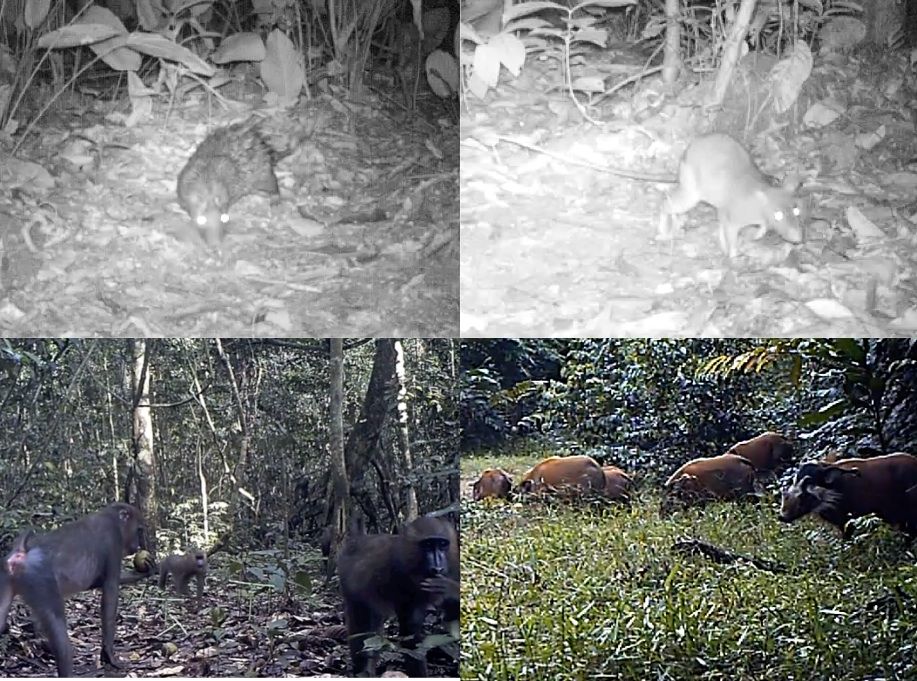
Some major seed predators of Gabon, "caught" by camera traps (clockwise, from top left): brush-tailed porcupine, Emin's giant rat, red river hog, mandrill
|
|
|
Seed predators can sometimes act effectively as seed dispersers. Agoutis, for example, are well-known for their scatterhoarding behavior in Neotropical forests. In Central Africa, both brush-tailed porcupines and giant rats remove large quantities of seeds from beneath fruiting trees, but the fate of these seeds is largely unknown. We've used telemetric seed transmitters to track seeds removed from experimental plots and match the fate of the seed with the identity of the seed predator. Watch the video at right to see this process in action: an Emin's giant rat drags a tagged seed (the radio transmitter trails behind on a thread) into its burrow - this is an example of larder-hoarding, which the seed is not likely to survive. You can read more about this project in our paper here.
|
|
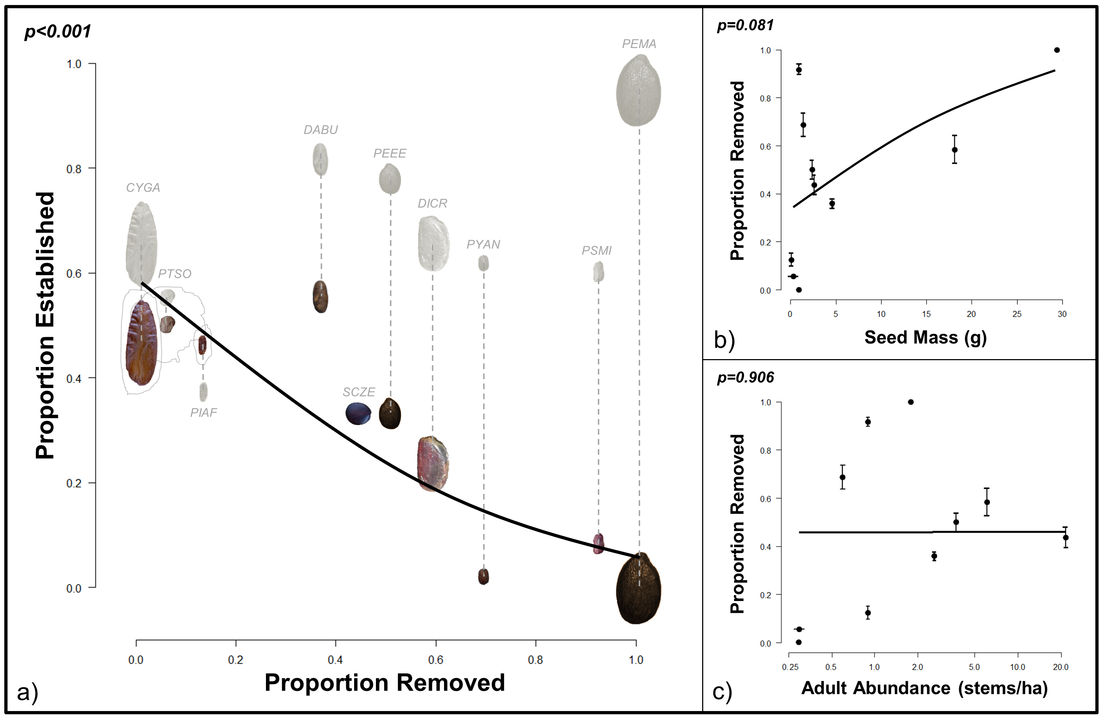
Seed predators (especially rodents) favor some seeds over others, and can strongly affect seedling establishment. Colored seeds represent Partial and Open treatments, while gray seeds represent the Closed exclosure treatment, demonstrating the strength of vertebrate effects.
|
|
